
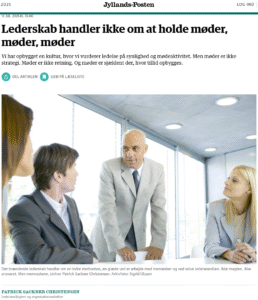
Read the article in Jyllands-Posten, one of the top three newspapers in Denmark (Danish) via this link:
By Patrick Sackner Christensen, Executive Coach and Culture Builder
Summer is calling. The sun is shining, and many employees are finally exhaling a little deeper. Meanwhile, countless leaders are already sitting in meeting rooms, meticulously planning the autumn ahead. Calendars are filling up with meetings, status check-ins and internal reviews. But in doing so, they risk forgetting the most important thing: to be present. To meet their people, sense the culture and speak with their employees, not about them.
In many organizations, leadership is misunderstood as a kind of busyness sport. The more meetings you attend, the more you appear to be leading, or so the unspoken belief goes. But that is a dangerous misconception. True leadership is not about filling your calendar. It is about investing in relationships. It is about presence, strategic clarity and creating the conditions for people to thrive.
Leadership is a choice. A choice to put people first. And that choice needs to be taken more seriously.
First impressions matter
Let us take a common scenario. You are stepping into a new leadership role. What do most people do? They immediately start booking meetings. It seems proactive. It creates visibility. But often, those meetings turn into symbolic gestures, rituals that do not build real understanding or connection.
The wise and courageous leader chooses a different path. They insist on a blank calendar for the first three to four weeks. Not to relax, but to listen. To walk around. To ask questions. To be curious. To observe how the team operates, where the energy flows and where it disappears. That is where leadership begins.
Trust begins with presence
Harvard professor Amy Edmondson has shown through her work on psychological safety that high-performing teams are built by leaders who create space for honesty, mistakes, doubt and dialogue. Psychological safety is not a soft skill. It is a core requirement for performance in today’s workplaces. And it begins with being present. Not through presentations, but through genuine interest.
A leader who knows their team’s names, dreams, challenges, strengths and limitations holds the key to real influence. That kind of leader does not just build well-being. They build results.
Relationships create real value
Gallup studies have shown that teams with engaged leaders have 21 percent higher profitability and 17 percent higher productivity. Employees who experience real recognition and support are 59 percent less likely to look for a new job within a year.
Furthermore, research from Harvard reveals that happy employees are on average 31 percent more productive, have 37 percent lower absenteeism and are three times more creative. It is not just good for morale. It is good for business.
Breaking the cycle of busyness
We have built a culture where leadership is measured by visibility and meeting activity. But meetings are not strategy. Meetings are not direction. And rarely are they where trust is built. That happens in the everyday moments. In the question “How are you really doing?” In the hallway, over coffee. In how you choose to show up, and in the signals you send when you choose people over tasks.
It takes courage. An empty calendar can feel like a confrontation with your own habits. But it is also an invitation to real leadership.
Choose presence, not pace
Leadership should not be defined by how busy you are. It should be defined by presence. By strategic awareness. By the courage to lead differently.
So next time you step into a leadership role, or return from vacation, let your first move be no move at all. Do not jump straight back into the hamster wheel of back-to-back meetings. Make yourself available to the people you are there to serve.
Because that is what leadership is. Not control. But servant leadership. And it begins with genuine interest.
Not in the task. But in the person.
At its core, this is about fervent leadership. And fervent leadership is driven by inner motivation. By the joy of working with people and embracing the leadership role in itself. Not by power. Not by responsibility. But by people.
So when you return from your holiday, ask yourself:
What will you choose? Leadership or the hamster wheel?