
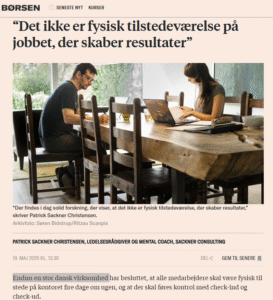
Read the article in Børsen top three news paper in Denmark (danish) via this link:
By Patrick Sackner Christensen, Executive Coach and Culture Builder
Yet another major Danish company has decided that all employees must be physically present at the office four days a week, and that check-in and check-out will be monitored. This resembles nothing more than a repetition of 1980s production logic, where trust was replaced by control, and presence was reduced to mere physical attendance.
Today’s top executives often affirm each other that this is the right way forward. Why? Because they’ve seen empty offices and felt unable to follow what employees were doing. In some cases, they’ve even had employees who didn’t do their jobs. But this is exactly where we as leaders must pause and ask ourselves: Is the solution really to pull everyone back into the office? No. The problem isn’t where people sit – it’s how we lead them.
It’s about alignment of expectations, continuous feedback, and trust. If an employee doesn’t deliver on what’s agreed, that’s not a reason to call everyone back in. It’s a leadership issue – and a question of whether we have the right people in the right roles. Controlling everyone just to catch a few is not effective leadership. It’s weak leadership. That’s why many seek confirmation in echo chambers – often networks filled with similar experiences and perspectives – instead of surrounding themselves with people who dare to ask questions and challenge decisions.
Today, there is solid research showing that physical presence does not in itself drive results. A 2024 study from Stanford University shows that employees who work from home two days a week are at least equally productive, more satisfied, and far less likely to quit. Another study, published in Nature, documents that hybrid work improves employee well-being without negatively impacting performance or career development.
At the same time, several recent studies show that especially younger employees under the age of 24 actually prefer being physically present – on average more than their older colleagues – because they seek community, learning, and creative interaction. So the picture is more nuanced than simply remote work versus office work.
And that’s exactly what’s missing from the debate: nuance. Some employees need the office – for the social aspect, better equipment, or to mentally close the workday when they leave. Others thrive with flexibility, calm, and self-management. The modern organisation manages to create frameworks where both can exist, depending on the task, the team’s needs, and individual well-being.
True leadership is not about control and fixed rules. It’s about setting direction, clarifying expectations, building trust, and providing feedback. And it’s about being open to challenge – not seeking approval in circles of like-minded people.
We must not fall back into old habits and outdated systems. We must evolve our leadership, our work culture, and our understanding of how individuals create value. The future does not call for control. It calls for courage and humanity.