“The most dangerous crisis in an organization is the loss of trust”
Read the article in Børsen top three news paper in Denmark (danish) via this link: Børsen When a leader breaks the trust contract, something fundamental happens. The agreement on openness, responsibility, and relationships crumbles. And when it crumbles, the glue that holds organizations together disappears. Distrust is not a feeling. It is a cultural force. And it moves faster than any strategy can keep up with. Research from Harvard Business Review shows that organizations with high trust perform significantly better. They experience higher engagement, greater productivity, and lower stress. When trust breaks, we see the opposite: less initiative, more noise, less courage. The culture loses its strength. Honesty is the foundation. This is where strong leadership begins. Period.Google documented in Project Aristotle that psychological safety is the strongest indicator of effective teams. But safety requires honesty. When leaders speak evasively or withhold essential information, uncertainty and speculation arise. Most employees can handle disagreement and change. What they cannot handle is the absence of clarity. The leader’s most important tool Leadership is communication—about direction, responsibility, and values. Honesty is the leader’s most important tool and the first thing that creates a strong culture. The absence of honesty is the first crack that creates a weak organization and culture, damaging the spiral of good leadership. My own work and my upcoming book show the same. A strong culture creates happier employees and stronger results. Culture is not a soft discipline. It is the bottom line. It is strategy. This also applies to politics. Political parties depend on credibility. When openness disappears and leaders are not clear, voters lose trust. Politics does not have an image problem. It has an honesty problem. Lack of clarity and lack of direction undermine engagement both internally and externally. Neuroleadership shows that honest and consistent communication reduces threat responses in the brain and strengthens the willingness to collaborate. Breaches of trust, on the other hand, have long-lasting consequences and require hard work to rebuild. This is not a style. It is a responsibility. The leader must protect trust. Because when trust breaks, culture, direction, and results break with it. Honesty is the foundation. This is where strong leadership begins. Period. Stronger culture, happier employees, better results Share this post
Stop quarterly capitalism – and start leading like an olympic athlete
Read the article in Børsen top three news paper in Denmark (danish) via this link: Børsen Motivation leads to success, not money! The future of your workplace depends on how how you are driving it. By Patrick Sackner Christensen, Executive Coach and Culture Builder 2025 is a year of uncertainty. The war in Ukraine continues, the conflict in the Middle East escalates, and Donald Trump’s return has stirred unease across markets and diplomacy. This instability trickles all the way down to people’s everyday lives — more stress, more worry, less psychological safety. In times like these, many companies instinctively tighten budgets, cut costs, and focus on the next quarterly report.But right now, more than ever, we need the opposite. Take the long view In elite sports, athletes don’t train for next week — they train for the next Olympics.Four years, sometimes eight. Along the way, they accept setbacks, but their focus remains long-term. In business, however, we often do the reverse.Quarterly expectations dominate. Investors demand quick wins. Boards fall for short-term logic born in the 1980s.The result? Lower innovation, weaker resilience, and disengaged employees. Leadership requires courage I often meet leaders caught in that tension. They want to build culture, but are forced to chase numbers.They want to create trust, but rarely find the time to listen.Yet that’s where leadership truly begins — in the courage to resist short-termism and lead with a longer horizon. Real leadership is about taking the long view. It’s about giving people ownership instead of control.The first creates energy, commitment, and growth.The latter creates compliance, overmanagement, and lost potential. Trust can’t be written on a poster It must be lived — in decisions, communication, and priorities.As LEGO’s Chief People Officer Loren I. Shuster puts it: “In the complex world in which we operate, you need people making decisions who are closest to the customer, the consumer, or supply chain partners.” Or as Corporate Rebels state even more simply: “Hire good people, then trust them with the freedom to get on with their job.” And research supports it: Happy employees are on average 12% more productive (University of Warwick). Higher engagement drives 21% better profitability and lower turnover (Gallup). Hope, optimism, and resilience strongly correlate with both performance and wellbeing (PsyCap meta-analyses). Lead like an Olympian Business needs more leaders who dare to play the long game — who think in four- or eight-year development cycles, set clear milestones, and build a culture that stands firm through turbulence. The message is simple:Quarterly capitalism suffocates potential. If we want stronger cultures, happier employees, and better results — we must start leading like Olympic athletes. Stronger culture, happier employees, better results Share this post
We must not return to the 1980s – we must move forward
Read the article in Børsen top three news paper in Denmark (danish) via this link: Børsen Motivation leads to success, not money! The future of your workplace depends on how how you are driving it. By Patrick Sackner Christensen, Executive Coach and Culture Builder Yet another major Danish company has decided that all employees must be physically present at the office four days a week, and that check-in and check-out will be monitored. This resembles nothing more than a repetition of 1980s production logic, where trust was replaced by control, and presence was reduced to mere physical attendance. Today’s top executives often affirm each other that this is the right way forward. Why? Because they’ve seen empty offices and felt unable to follow what employees were doing. In some cases, they’ve even had employees who didn’t do their jobs. But this is exactly where we as leaders must pause and ask ourselves: Is the solution really to pull everyone back into the office? No. The problem isn’t where people sit – it’s how we lead them. It’s about alignment of expectations, continuous feedback, and trust. If an employee doesn’t deliver on what’s agreed, that’s not a reason to call everyone back in. It’s a leadership issue – and a question of whether we have the right people in the right roles. Controlling everyone just to catch a few is not effective leadership. It’s weak leadership. That’s why many seek confirmation in echo chambers – often networks filled with similar experiences and perspectives – instead of surrounding themselves with people who dare to ask questions and challenge decisions. Today, there is solid research showing that physical presence does not in itself drive results. A 2024 study from Stanford University shows that employees who work from home two days a week are at least equally productive, more satisfied, and far less likely to quit. Another study, published in Nature, documents that hybrid work improves employee well-being without negatively impacting performance or career development. At the same time, several recent studies show that especially younger employees under the age of 24 actually prefer being physically present – on average more than their older colleagues – because they seek community, learning, and creative interaction. So the picture is more nuanced than simply remote work versus office work. And that’s exactly what’s missing from the debate: nuance. Some employees need the office – for the social aspect, better equipment, or to mentally close the workday when they leave. Others thrive with flexibility, calm, and self-management. The modern organisation manages to create frameworks where both can exist, depending on the task, the team’s needs, and individual well-being. True leadership is not about control and fixed rules. It’s about setting direction, clarifying expectations, building trust, and providing feedback. And it’s about being open to challenge – not seeking approval in circles of like-minded people. We must not fall back into old habits and outdated systems. We must evolve our leadership, our work culture, and our understanding of how individuals create value. The future does not call for control. It calls for courage and humanity. Stronger culture, happier employees, better results Share this post
Leadership isn’t about meetings. It’s about people
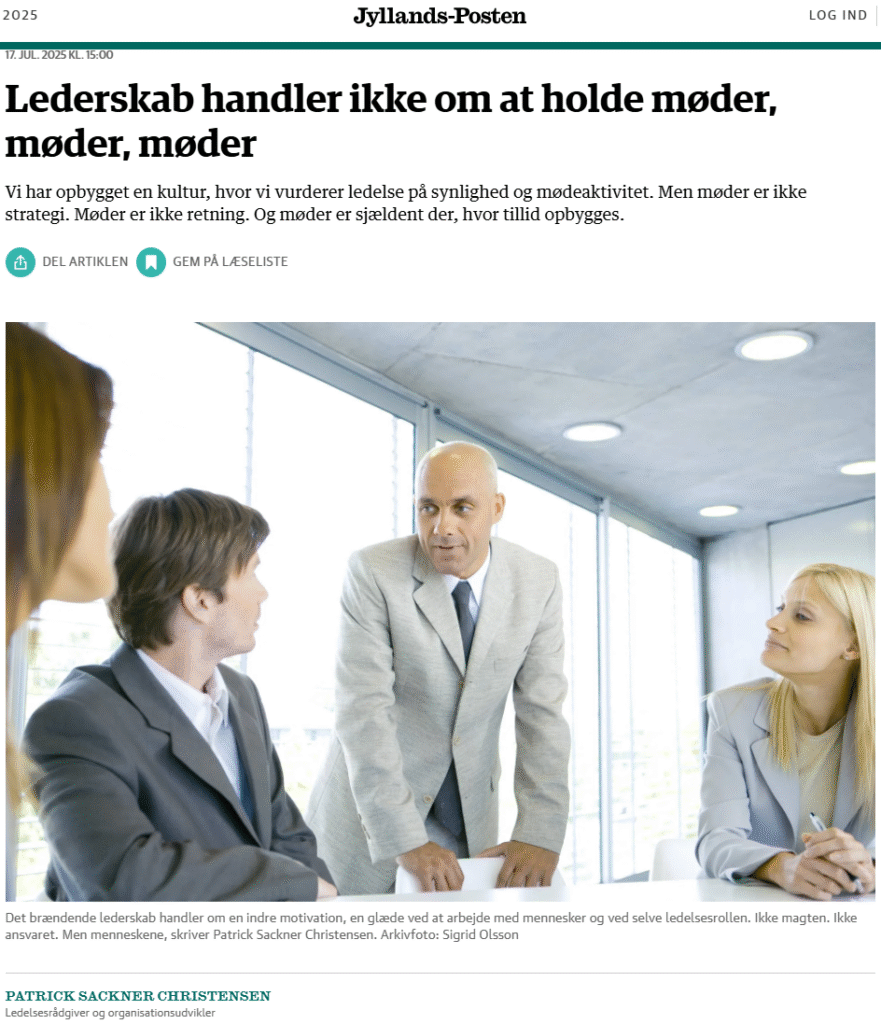
Read the article in Jyllands-Posten, one of the top three newspapers in Denmark (Danish) via this link: Jyllands-Posten Motivation leads to success, not money! The future of your workplace depends on how how you are driving it. By Patrick Sackner Christensen, Executive Coach and Culture Builder Summer is calling. The sun is shining, and many employees are finally exhaling a little deeper. Meanwhile, countless leaders are already sitting in meeting rooms, meticulously planning the autumn ahead. Calendars are filling up with meetings, status check-ins and internal reviews. But in doing so, they risk forgetting the most important thing: to be present. To meet their people, sense the culture and speak with their employees, not about them. In many organizations, leadership is misunderstood as a kind of busyness sport. The more meetings you attend, the more you appear to be leading, or so the unspoken belief goes. But that is a dangerous misconception. True leadership is not about filling your calendar. It is about investing in relationships. It is about presence, strategic clarity and creating the conditions for people to thrive. Leadership is a choice. A choice to put people first. And that choice needs to be taken more seriously. First impressions matter Let us take a common scenario. You are stepping into a new leadership role. What do most people do? They immediately start booking meetings. It seems proactive. It creates visibility. But often, those meetings turn into symbolic gestures, rituals that do not build real understanding or connection. The wise and courageous leader chooses a different path. They insist on a blank calendar for the first three to four weeks. Not to relax, but to listen. To walk around. To ask questions. To be curious. To observe how the team operates, where the energy flows and where it disappears. That is where leadership begins. Trust begins with presence Harvard professor Amy Edmondson has shown through her work on psychological safety that high-performing teams are built by leaders who create space for honesty, mistakes, doubt and dialogue. Psychological safety is not a soft skill. It is a core requirement for performance in today’s workplaces. And it begins with being present. Not through presentations, but through genuine interest. A leader who knows their team’s names, dreams, challenges, strengths and limitations holds the key to real influence. That kind of leader does not just build well-being. They build results. Relationships create real value Gallup studies have shown that teams with engaged leaders have 21 percent higher profitability and 17 percent higher productivity. Employees who experience real recognition and support are 59 percent less likely to look for a new job within a year. Furthermore, research from Harvard reveals that happy employees are on average 31 percent more productive, have 37 percent lower absenteeism and are three times more creative. It is not just good for morale. It is good for business. Breaking the cycle of busyness We have built a culture where leadership is measured by visibility and meeting activity. But meetings are not strategy. Meetings are not direction. And rarely are they where trust is built. That happens in the everyday moments. In the question “How are you really doing?” In the hallway, over coffee. In how you choose to show up, and in the signals you send when you choose people over tasks. It takes courage. An empty calendar can feel like a confrontation with your own habits. But it is also an invitation to real leadership. Choose presence, not pace Leadership should not be defined by how busy you are. It should be defined by presence. By strategic awareness. By the courage to lead differently. So next time you step into a leadership role, or return from vacation, let your first move be no move at all. Do not jump straight back into the hamster wheel of back-to-back meetings. Make yourself available to the people you are there to serve. Because that is what leadership is. Not control. But servant leadership. And it begins with genuine interest. Not in the task. But in the person. At its core, this is about fervent leadership. And fervent leadership is driven by inner motivation. By the joy of working with people and embracing the leadership role in itself. Not by power. Not by responsibility. But by people. So when you return from your holiday, ask yourself:What will you choose? Leadership or the hamster wheel? Stronger culture, happier employees, better results Share this post
Exploring Human Motivation by Nurturing Growth and Excellence
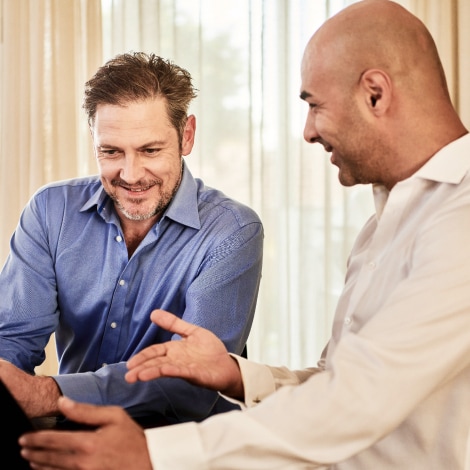
Motivation leads to success, not money! The future of your workplace depends on how how you are driving it. by Patrick Sackner Christensen In the intricate landscape of human psychology, one driving force stands out – motivation. It’s the engine behind our actions, the catalyst for our achievements, and a topic that has captured my attention for years. Today, I’m excited to take you on a journey into the heart of human motivation, sharing insights that can help us nurture growth and excellence in both individuals and teams. At its core, motivation is a blend of two key elements: intrinsic and extrinsic motivation. Intrinsic motivation comes from within – it’s the joy we find in doing something purely for the love of it. Extrinsic motivation, on the other hand, comes from external rewards like recognition or tangible benefits. Balancing these two forces is crucial, as they shape our behaviors and drive us forward. Empowering Through Goal Setting As someone deeply involved in talent development and leadership, I’ve witnessed the power of goal setting. Goals provide direction and purpose, igniting motivation to achieve more. When aligned with personal values and aspirations, goals become powerful drivers of progress. Regular feedback and acknowledgment further enhance motivation, reinforcing the link between effort and success. Our motivations are as diverse as we are. Recognizing this diversity is essential in leadership roles. Through my journey and experience, I’ve learned that tapping into individual motivations can create an environment where everyone feels valued and driven to excel. Tailoring strategies to resonate with each team member’s intrinsic drivers can lead to remarkable outcomes. Drawing from my background as an elite swimmer, a leadership expert, and a certified professional, I’ve come to appreciate the interplay between psychology and leadership. Merging these realms allows us to foster a holistic approach to motivation. By understanding the psychological aspects that drive us, we can cultivate environments where growth, well-being, and success flourish. A Path Forward In a world where motivation is the heartbeat of progress, our journey takes us to a place where understanding, empathy, and strategy intersect. By recognizing the dual nature of motivation, embracing theories like SDT (see below), setting meaningful goals, and respecting individual motivations, we can guide ourselves and others towards growth and excellence. So, let’s embark on this exploration together – one that unveils the secrets of motivation and empowers us to reach new heights. The Self-Determination Theory The Self-Determination Theory (SDT) sheds light on how we can fuel motivation effectively. It highlights three innate needs: autonomy, competence, and relatedness. Acknowledging these needs within ourselves and others can lead to greater motivation and overall well-being. As leaders, understanding and addressing these needs can significantly impact team dynamics and productivity. Remember culture eats strategy for breakfast Share this post
Why learn about different cultures

It is important for our businesspeople to learn about team culture for several reasons Increased collaboration: Understanding different team cultures can improve collaboration between Korean and European business teams. By learning how teams in different cultures operate, leaders can ensure that all members feel comfortable and valued, which can improve team performance and productivity. Improved communication: Different team cultures have different communication styles and expectations. By learning about these differences, Korean and European businesspeople can communicate more effectively, avoid misunderstandings, and build stronger relationships. Cultural sensitivity: Being aware of different team cultures can help avoid unintentionally offending or disrespecting their colleagues. This can be especially important when working on cross-cultural projects, where misunderstandings can have significant consequences. Adaptability: Learning about different team cultures can also help Korean and European teams become more adaptable. By understanding how teams in different cultures operate, they can adjust their own behavior to better align with the expectations and norms of their colleagues. Globalization: As globalization continues to increase, working across cultures is becoming more common. By learning about different team cultures, Korean and European teams can be better prepared to work with colleagues from all over the world. Overall, learning about European team culture is important for the Korean team and vice versa because it can improve collaboration, communication, cultural sensitivity, adaptability, and preparedness for working in a globalized world. Share this post
Do you have a culture coach?
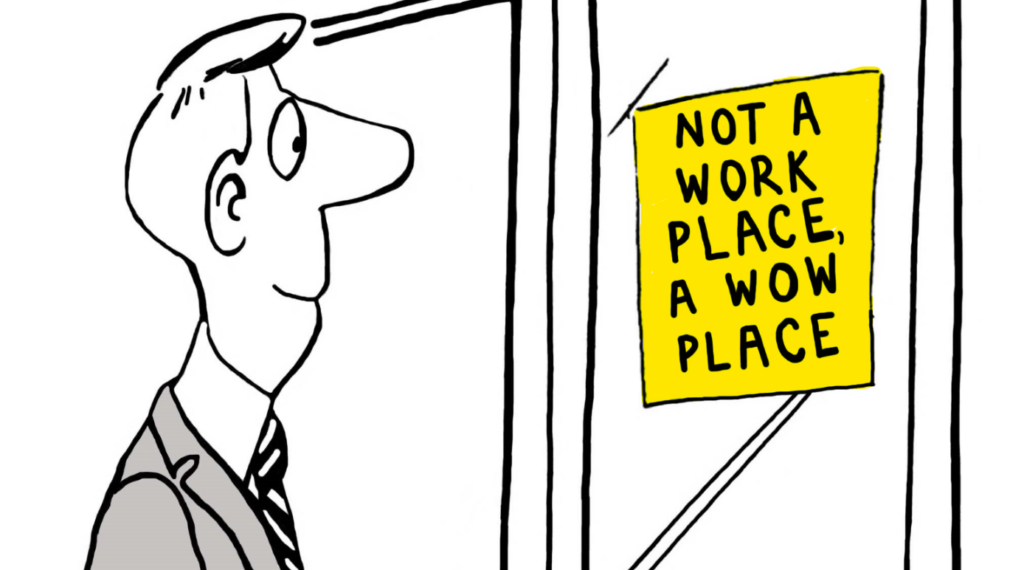
Or do you let the culture drive without a license? The future of your workplace depends on who is driving it. by Patrick Sackner Christensen Who is driving the culture in your company and do they have a license? Did you know that a thriving company culture leads to more than four times higher revenue growth? Future of work, LMS, digital fit, thought-leadership, servant leadership, way of working, flexible working hours, 4 days work-week, remote working, covid adjustments,… and many other subjects are being mentioned in today’s discussions in newspapers, social media, established companies, startups, and many more places. It is all very interesting subjects and important for you, me and others for sure. For all this and much more the culture is and will always be the driver – and whom are you having to drive the culture within your company? Do they have a license to drive? Project managers are everywhere but where is the passion coach? Perhaps you are thinking, what does he mean by “who is driving”, but as you know “culture eats strategy for breakfast” (Peter Drucker), which is why I want you to consider 1) who is driving the culture within your company and 2) do they have a license? Presented in the report; State of the American Workplace, only 33% of employees were engaged in their work. This is why we must act differently. For many years I have got the opportunity to work with project managers certified within Adkar, IPMA, CSM(Scrum), PMP, Prince2, and many more – and I do hear many companies working with an Agile setup – with Agile coaches – taking care of the “road” making sure the setup is followed. But what they all have together is, that people are only one of many factors they are looking at – and this is usually not their specialty (people). Why I am mentioning project managers is, that most companies have certified project managers but very few have someone hired to only taking care of the culture, the passion, the employee experience which I believe is also why many companies don’t succeed as good as they can or want to. Employee motivation is 17 to 33 percent higher when profit is not the primary focus. Goals can be achieved in many ways, it’s a matter of how you do it. While working on this article I have been looking at job sites too, as they often give an understanding and view of, what companies are looking for (a bite of it at least, and then I have followed up by personal interviews). First, I have experienced that when companies want to hire employees to HR/People & Culture roles, the job description is only partly about culture, as there is much more included such as laws and regulation, recruitment, administration and much more. With these divided tasks, it is impossible to focus on the most important task – the passion and energy of the employees. Second, I often see roles such as CEO, CFO, CCO, COO which of course are very important roles- but where is the Organizational Developer, or the Culture Coach? Those roles who solely need to take care of your employee’s happiness – making sure your employees are motivated, engaged, and filled with energy? 93 percent are more committed when you as an employee experience a high degree of meaning in your working life. Furthermore, 74 percent don’t believe that they fulfill their full potential at work. Employee motivation is 17 to 33 percent higher when profit is not the primary focus. Passion Director According to new research of more than 600 US businesses with 50-500 employees, 63.3% of companies say retaining employees is harder than hiring them. Still, most companies don’t dare to leave the KPI’s behind and letting KBI’s (Key Behavior Indicator) be the drivers – why is that? In my research, I was told by my wife to look into Linda Hammarstrand –former Director of Passion and part of Clarion Hotel’s management team. She was responsible for the corporate culture and for making Clarion Hotel the Nordics region’s most attractive employer. Again Petter Stordalen has dared to do something different and with huge success. In a major long-term study, companies that had the best corporate cultures, that encouraged all-around leadership initiatives, and that highly appreciated their employees, customers, and owners grew 682 percent in revenue. During the same period of evaluation— 11 years — companies without a thriving company culture grew only166 percent in revenue. This means that a thriving company culture leads to more than four times higher revenue growth. Still, thinking about who is driving your culture? Still, thinking about why you should be looking more into making sure that your employees are happy and motivated? Okay here goes: Engaged employees outperform their peers that are not engaged. Overall, companies with high employee engagement are 21% more profitable. Employee engagement improves morale in the workplace. Employee engagement reduces absenteeism. In fact, a Gallup study shows that highly engaged workplaces saw 41% lower absenteeism. Engaged employees provide better customer service. Low employee engagement is a costly problem! It costs businesses $4,129 on average to hire new talent, and around $986 to onboard the new hire. That means you lose over $5,000 each time an employee walks out the door, not to mention the unquantifiable cost of losing an experienced employee Remember culture eats strategy for breakfast Share this post Share on facebook Share on google Share on twitter Share on linkedin Share on pinterest Share on print Share on email Links to informations used in the article https://www.zenefits.com/workest/employee-turnover-infographic/ https://www.forbes.com/consent/?toURL=https://www.forbes.com/sites/johnkotter/2011/02/10/does-corporate-culture-drive-financial-performance/#7e87df117e9e https://www.forbes.com/sites/johnkotter/2011/02/10/does-corporate-culture-drive-financial-performance/#7e87df117e9e https://blog.smarp.com/what-is-the-true-cost-of-poor-employee-communication https://www.gallup.com/workplace/236366/right-culture-not-employee-satisfaction.aspx https://www.shrm.org/about-shrm/press-room/press-releases/pages/human-capital-benchmarking-report.aspx https://trainingmag.com/sites/default/files/trn-2018-industry-report.pdfhttps://lindahammarstrand.se/ https://blog.smarp.com/employee-engagement-8-statistics-you-need-to-know
Leadership in the future